


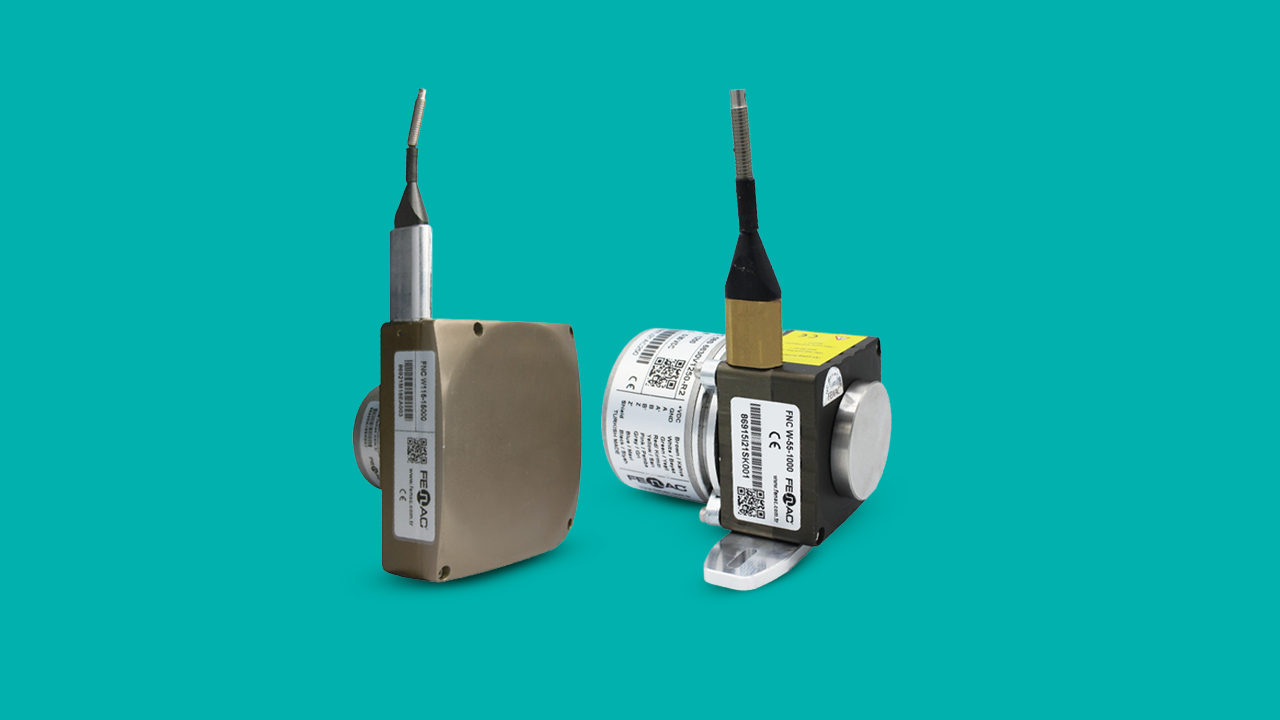
What Is a Draw Wire Encoder? Working Principle and Applications in Linear Position Measurement
Draw wire encoders are industrial position measurement systems designed to measure linear movement. A flexible steel wire is attached to the moving component, and as the wire extends or retracts, it rotates a drum inside the mechanism. A connected rotary encoder converts this rotation into electrical signals, allowing the system to determine linear distance and position.
Depending on the application, draw wire mechanisms can be combined with incremental, absolute, or analog-output encoders. This design provides a compact solution for measuring relatively long linear movements. Typical applications include machine automation, lifting systems, hydraulic cylinders, mobile machinery, and production lines.
Fenac offers draw wire encoder solutions through its FNC W55, W80, W80P, W100, W100 Pro, W115, and W120 series. Depending on the model, the available measurement lengths range from 3,000 mm to 20,000 mm.
The appropriate rotary encoder and output type can be selected according to the automation system requirements. Explore Fenac draw wire products to find a suitable solution for your machine's measurement range and connection needs.