


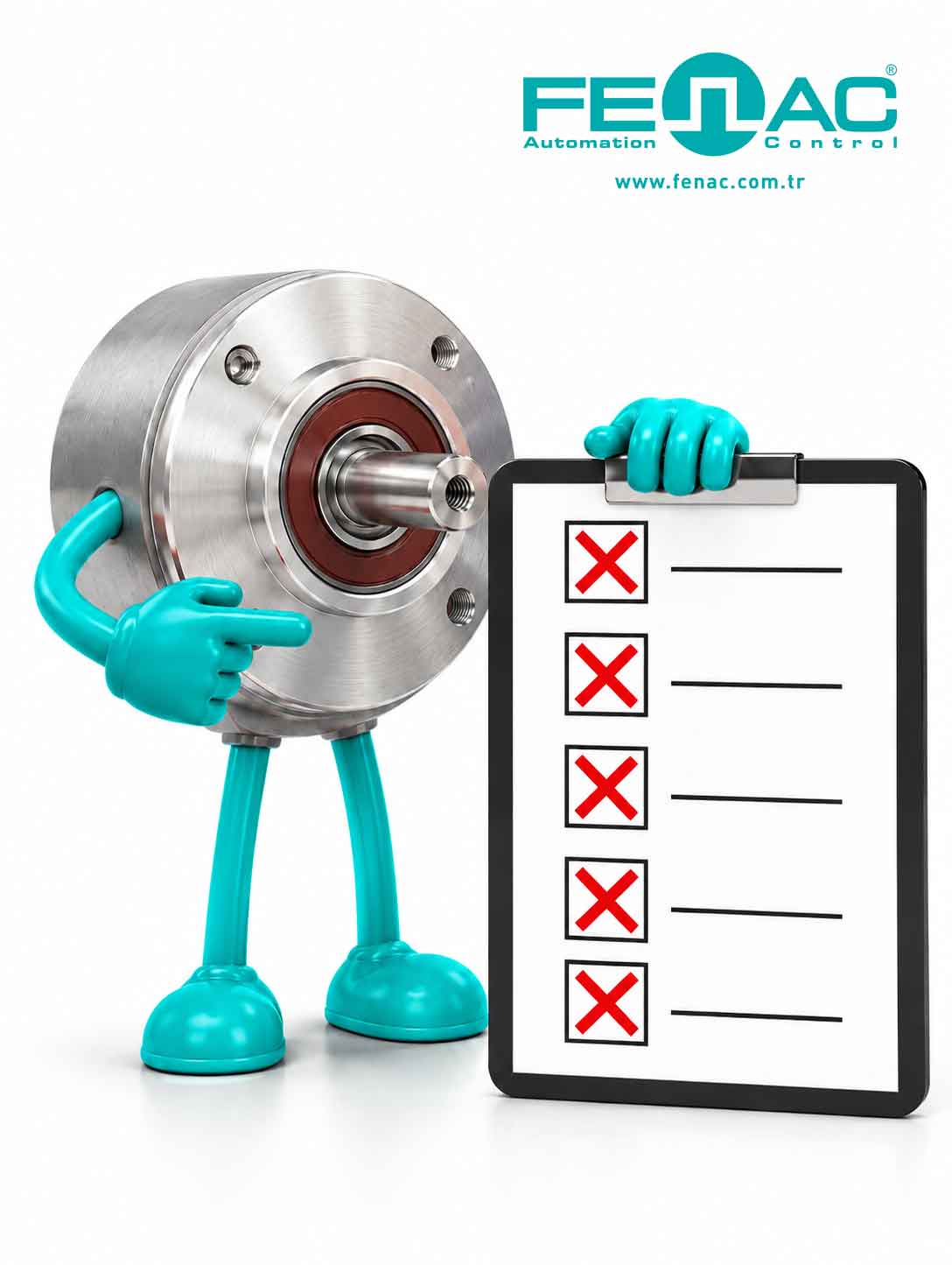
5 COMMON MISTAKES WHEN SELECTING AN ENCODER
Choosing the right encoder plays an important role in ensuring that a machine operates accurately, reliably, and efficiently. However, selections made without properly analyzing the application's requirements can lead to measurement errors, performance losses, and unexpected downtime.
So, what are the most common mistakes when selecting an encoder?
1. Focusing Only on Resolution
Resolution is an important criterion when selecting an encoder, but it is not the only factor to consider. The accuracy required by the application, measurement range, and control system should all be evaluated together. Choosing a resolution that is either unnecessarily high or insufficient can negatively affect system performance.
2. Overlooking the Difference Between Incremental and Absolute Encoders
Incremental and absolute encoders operate based on different principles. Incremental encoders track movement through pulses, while absolute encoders provide position information as a specific digital value. Selecting the wrong technology for the application can lead to undesirable results in the control system.
3. Failing to Check Mechanical Compatibility
Shaft diameter, housing dimensions, mounting method, and connection type should all be considered when selecting an encoder. Overlooking mechanical compatibility can result in installation difficulties, vibration, and mechanical stress.
4. Ignoring Operating Conditions
Not every encoder is suitable for every operating environment. Environmental factors such as dust, moisture, temperature, vibration, and shock should be evaluated during the selection process. Technical specifications such as the protection rating and operating temperature must be compatible with the application's conditions.
5. Neglecting Electrical Connection and Communication Requirements
The encoder must be compatible with the control system. The output signal, supply voltage, connection type, and communication protocol must be correctly specified. Any incompatibility with the control system can cause integration issues and data transmission problems.
THE RIGHT CHOICE FOR RELIABLE MOTION CONTROL
Encoder selection is about more than simply choosing a product. The application's mechanical structure, operating environment, accuracy requirements, and control system must all be evaluated together.
An encoder selected with the right technology and technical specifications provides an essential foundation for more reliable measurement, stable operation, and a more efficient automation system.